
Recent News
Read on the Marin IJ website, or below.
No one disagrees that the Marinship area of Sausalito needs to take a step forward.
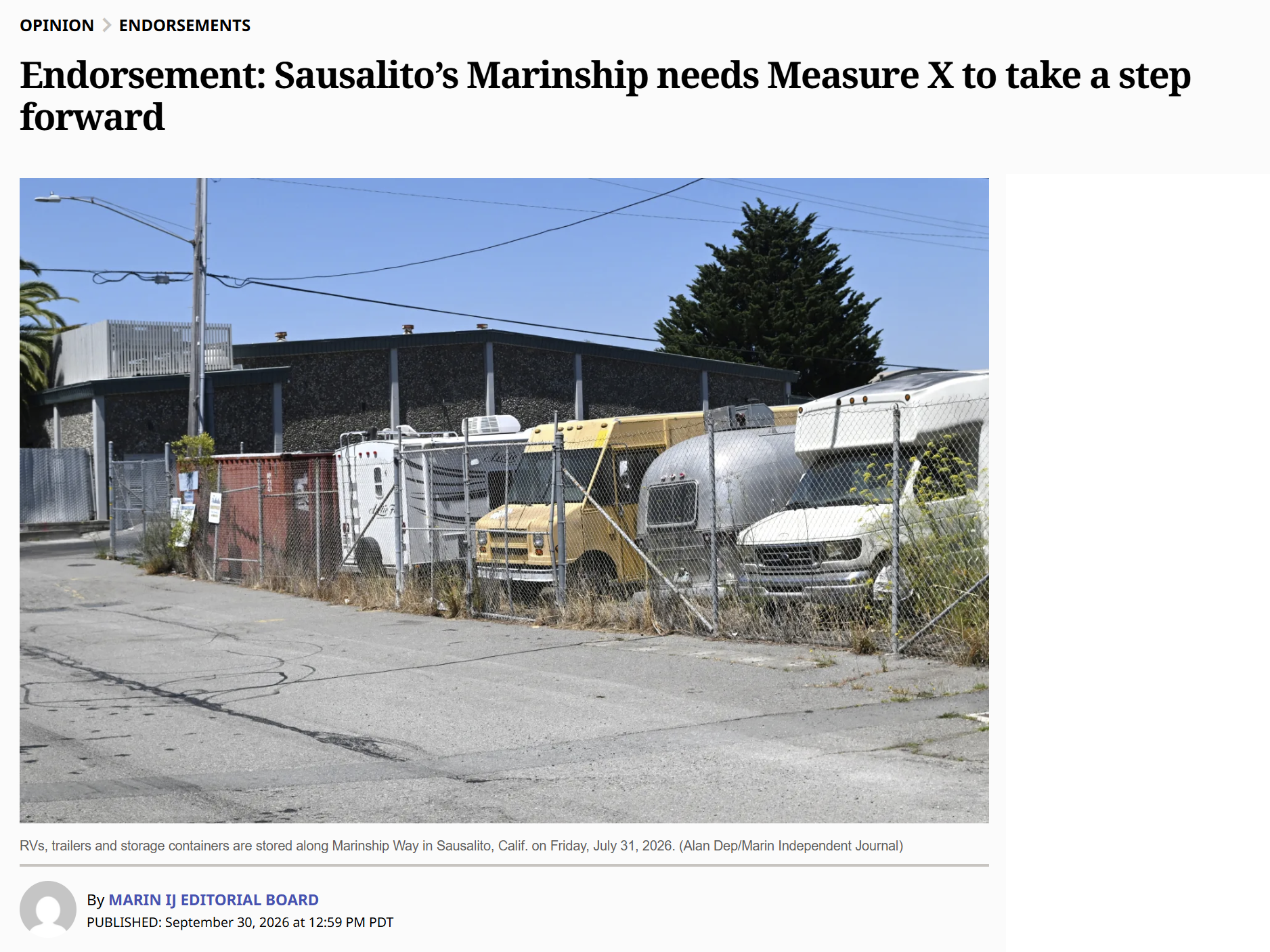
The 210-acre former World War II shipyard region between Bridgeway and Richardson Bay in the northern part of the city is plagued by vacant offices, decaying structures, rotting vehicles and tidal flooding that promises to get worse.
Measure X on the November ballot would rezone commercial parcels from Spinnaker Point north, including two-thirds of the Marinship area. It does not create housing sites or affect the historic downtown.
Supporters say Measure X will more sensibly address issues related to a 40-year ordinance that has resulted in an inability to grant business development plans, which has chased commerce and its tax base from the city for decades.
Opponents say Measure X grants sweeping new rights to industrial developers without enough planning to protect the waterfront and some of the smaller local institutions – like artist collectives – located there.
The plea from the co-owner of Heath Ceramics, a Marinship-based business that built a national reputation, is of interest. Several years ago, Robin Petravic reached out to the city with seemingly reasonable requests to build a new roof that would allow more indoor business activities. The owners were told that, because of the 1980s ordinance, any changes would need to be approved with a measure on the ballot by voters, which would likely require a costly campaign. Faced with those obstacles locally, Heath turned to San Francisco, where it was able to build what it needed with much less hassle and cost.
Clearly putting land-use requirements like that to the entire voting public goes beyond even the usual anti-business sentiments. As businesses in the area leave, shrivel or struggle to maintain status quo, rusty and broken old buildings, as well as vehicles, remain. That’s not preservation, that’s willful disregard.
The group in opposition knows something needs to change. However, it is concerned that the supporters’ promise of the Sausalito City Council and Planning Commission having mechanisms to shape commercial development in the area the way residents would like isn’t spelled out in the language of the proposal. It says it will have a better plan in the near future that is business-friendly with more protections against large-scale development.
“When voters were offered a chance to vote for a well-thought-out measure for development, they supported it,” said Sophia Collier of the group in opposition during a meeting with the IJ editorial board when referencing recently successful measures J and K for more housing. “So we know Sausalito can make changes through a voter approach. Voter control has protected the city for 40 years. We want to make sure it continues now.”
With 40 years of neglect already under its belt, the marine-based businesses along the waterfront may not be able to wait much longer. And where opponents say wording of Measure X includes possible loopholes, supporters say the proposal is safe with many protections controlled by elected city leaders.
As global warming contributes to sea-level rise, Marinship finds itself in danger of slipping below the waterline. Permitting new industrial construction for expanded business proposals is one way to gather tax dollars to address the impacts of climate change. This needs to be addressed now, before things get worse.
“Sausalito has more than $100 million in deferred infrastructure costs,” said Councilmember Ian Sobieski, who was a representative of the group in support of Measure X in a meeting with the editorial board. “Economic development would provide a funding source. Do we take a step forward or not?”
We have been here before with Marinship. Others have spoken up in the past about making changes in the area. However, each time, plans have quickly been slapped down by residents fearful of growth. It is a Sausalito tradition to stop proposals and promise a better plan in the future.
But no significant plan has ever been approved and little has really changed. Measure X is a positive step in the right direction. Sausalito can no longer afford inaction.
The IJ editorial board supports Measure X in the November election to allow business-related zoning changes in Marinship.

Read on the Marin IJ website, or below.
Sausalito is in a pitched battle over Measure X, an initiative on the November ballot that would change zoning regulations and permit a broader range of uses and larger buildings in its waterfront districts.
This area of town has remained largely dormant under current regulations, basically frozen in 1987. Sensible reforms that replace rigid and oppressive regulations will encourage diversification and investment that will fund overdue infrastructure improvements, generate revenue for the city and revitalize this beautiful, but very vulnerable, resource.
Measure X seems like a win-win for everyone. However, some opponents want to stop reform by deferring it. Personally, I think it could work.
No one wants mistakes that might stain the landscape for generations. A judicious dose of inertia is a good thing in a democracy. But, at some point, debate will become a pretext to procrastinate. Through inaction, we cede our future to outside forces of decay and financial atrophy. When given the opportunity, a failure to act is itself an act.
No measure is perfect. Democracy is messy. I say vote for the better solution presented, not the best solution in theory. Is Measure X better than the status quo? Absolutely. Are there available processes to improve it where needed? By rolling back Ordinance 1022, that process becomes available. Is there reason to believe waiting more years will produce a plan any better than the current proposal? Experience tells me there is not.
Measure X rolls back an ill-conceived ordinance that has crippled our elected representatives’ ability to govern. It removes more than 250 pages of shortsighted regulations that have stifled economic development for two generations. It updates our zoning code to ensure that our working waterfront can continue to support maritime businesses, incubate new industry and cultivate the arts.
Sausalito’s future lies ahead and it is time to move forward.
— David Marlatt, Sausalito

Read on the Marin IJ website here or below.
On the Nov. 5 ballot, Sausalito voters will be asked to pick three City Council members. Two incumbents, Melissa Blaustein and Ian Sobieski, are seeking second terms. Councilmember Janelle Kellman is stepping down as she ramps up her campaign for lieutenant governor in 2026.
The race has drawn three solid challengers – former Mayor Sandra Bushmaker, former Marin County Counsel Steven Woodside and Jacqueline Amrikhas, local certified public accountant.
Over the past few years, Sausalito has faced significant challenges. The response to the COVID-19 pandemic closed much of downtown, limiting the sales tax and parking charges on which the city budget relies.
The city had the costly challenge of a homeless encampment and the lawsuits it generated. In addition, the city lost its insurance coverage due to excessive losses. It is paying significantly more for new coverage. The city is also facing the task of repairing its aging streets, sewers, drainage systems and landslide risks.
Blaustein and Sobieski have proven to be two strong council members and should be retained. Blaustein is enthusiastic and provides the perspective “of a younger generation” to city discussions. Sobieski is a problem solver and says he looks for opportunities for collaborative resolution.
“I block and tackle problems,” he says, calling himself “an out-of-the-box thinker.”
Bushmaker, an attorney and mediator, says the council and City Hall need the institutional memory she has about the city. She served on the council, including two terms as mayor, from 1998 to 2002. She’s stayed involved and would be a good addition to the council.
Woodside also offers a depth of experience, especially in municipal law and management. He is a former Marin County Counsel, having served in that post after years of working for Santa Clara and Sonoma counties.
He knows the law. He knows the city’s legal responsibilities, liabilities and limitations. The breadth of his governmental experience could be what the City Council needs as it navigates issues from liabilities to complying with the state mandate that the city build 724 units of housing over the next seven years.
Woodside says his goal is to bring “civility” to city discussions. He’s also voiced concern about the neighboring Golden Gate National Recreation Area doing its part to support the Marin Wildfire Prevention Authority’s work to create “defensible space around our town.”
Among the candidates, there’s not much support for a proposed multi-story 57-unit housing complex along Bridgeway. Bushmaker, for example, says it’s too large and doesn’t fit the historic character of the area. Building “luxury” housing, she says, is not an answer to the city’s shortage of affordable housing. Amrikhaus calls the proposal “a monstrosity.”
All but Amrikhas support the city’s formation and investment in a downtown Business Improvement District. Woodside says it has strong propertyowner support. Sobieski and Blaustein say the city’s investment is aimed at boosting local business, which should increase city tax and parking revenue.
Both Amrikhas, Bushmaker and Woodside are critical of the county’s lengthy meetings that stretch beyond midnight and Woodside suggests the council adopt a 10 p.m. curfew. Bushmaker and Sobieski say the council should hold more meetings, if necessary.
Amrikhas is likely the voters’ choice if they feel the city is headed in the wrong direction, especially financially. She says the council is making decisions based on “fantasy numbers.”
Bushmaker and Woodside both offer experience in local government leadership. Bushmaker already has had a chance on the council. Woodside offers a breadth of experience in municipal governance and administration that could prove valuable to any council.
Many believe this election could be a close call with divergent views about what needs to change. In the Sausalito council race, the IJ editorial board recommends incumbents Melissa Blaustein and Ian Sobieski, as well as challenger Steven Woodside, on the Nov. 5 ballot.
Other News
Profile:
Quoted in the News:
Sausalito readies $1.3M contract for ferry landing project, Marin Independent Journal, July 28, 2024
Marin celebrants gear up for Fourth of July, Marin Independent Journal, July 2, 2024
Mayor Ian Sobieski to Inaugurate Certified-Sausalito Farmers Market, The Patch, June 2, 2024
Sausalito advances plan for business district, Marin Independent Journal, June 10, 2024
Sausalito swears in 1st LGBTQ+ police chief: Meet Officer Stacie Gregory, AB7 News, Jan. 14, 2024
Sausalito considers options for parking management, Marin Independent Journal, Sept. 30, 2023

